
Content Guide
The Mountain review: There is a moment near the end of The Mountain where everything goes quiet. Not silent, exactly, but stripped back to something essential: a flute, a gentle hand on the drum, Damon Albarn singing as though nobody is listening. It is the kind of moment that makes you feel like you have stumbled into something private. And in a sense, you have.
In 2024, Albarn lost his father Keith. Ten days later, Jamie Hewlett lost his. The two men, who by their own admission had spent years drifting apart as a creative partnership, found themselves sitting with the same unasked question at the same time: what do you do with grief this big? Their answer was to go to India, scatter ashes in the Ganges, watch bodies burn on the banks at Varanasi, and then make the ninth Gorillaz record. Of course they did.
The Mountain is the album that resulted from all of that, and it is something genuinely rare: a record made in direct response to death that does not feel morbid in the slightest. It feels alive. More than that, it feels like the most purposeful thing this project has produced since Plastic Beach. The kind of album you sit with from beginning to end, which is precisely what Hewlett wants you to do.
The Concept and the Collaborators (The Mountain Review)
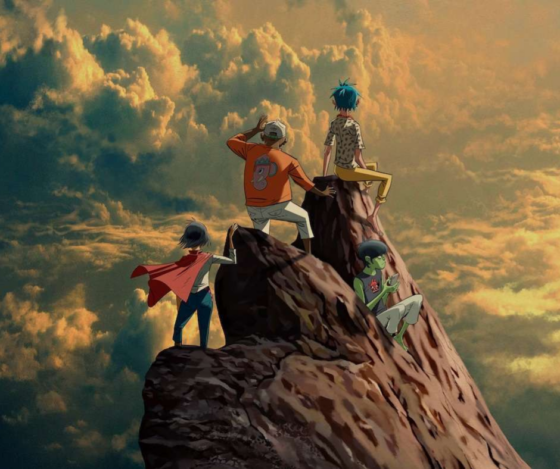
The album operates on a central metaphor that Hewlett describes simply: the mountain as a human life. At the base, everything is wide and green and full of possibility. The higher you climb, the narrower the path becomes. And at the very summit? That is where reincarnation begins. Hindu and Sikh attitudes toward death, which frame it as transition rather than ending, gave both men something British funeral culture beside a ring road on a grey afternoon simply could not.
Albarn has spoken about his childhood being soundtracked by Ravi Shankar before the Beatles got there, and that personal history runs through every corner of The Mountain. Anoushka Shankar, Ravi’s daughter, appears on six of the fifteen tracks as the album’s most constant musical presence, her sitar weaving through the record like a thread you keep finding in a different colour. The connection between them goes deeper than music: when Albarn’s father was dying in hospital, he played a Ravi Shankar morning raga. His father, he said, came back for twenty minutes.
Beyond Shankar, the collaborator list is extraordinary. Johnny Marr plays on four tracks. Black Thought appears on three. IDLES contribute to one of the most unsettling tracks on the record. Yasiin Bey, Paul Simonon, Sparks, Bizarrap, Kara Jackson, Omar Souleyman, Asha Bhosle (at 91 years old, recorded in her Mumbai apartment), Trueno, and Gruff Rhys all pass through.
The record also features six posthumous appearances: vocal takes from Tony Allen, Bobby Womack, Dave Jolicoeur (Trugoy the Dove of De La Soul), Proof, Mark E. Smith, and Dennis Hopper, each unearthed from old session archives. In the original Gorillaz lore, the character Russel Hobbs could summon the voices of dead musicians. It took 25 years, but they finally did it for real.
The Singles: What They Told Us Before the Album Arrived (The Mountain Review)
Five singles rolled out across five months before the album dropped, giving us roughly 40% of the record in advance. Taken together they painted a picture of something genuinely adventurous.
The Happy Dictator, featuring Sparks, arrived first and immediately signalled that this would not be another cautious Gorillaz release. Inspired by Albarn’s visit to Turkmenistan, where a former dictator banned all negative news and ordered citizens to think only happy thoughts, the track is synth-pop political theatre. Russell Mael’s operatic vocal soars over tight, brittle production while Albarn mumbles beneath him, deadpan and sardonic. The contrast is the joke and the point simultaneously. It is one of the best things either act has released in years.
The Manifesto followed in October and is probably the most ambitious track on the album. At seven minutes and nineteen seconds, it moves from hypnotic Indian instrumentation and Argentine rapper Trueno singing about mortality across two languages, then pivots completely around the three-minute mark into a relentless hip-hop beat carrying a posthumous verse from Proof, the D12 rapper killed in 2006. His raw, unfinished vocal was captured during the Demon Days sessions. It arrives here like a ghost in the machine, raw and completely unhomogenised, and the effect is startling. It does not feel like a nostalgia exercise. It feels like unfinished business.
The God of Lying with IDLES is the darkest single by some distance. Joe Talbot, normally a performer of coiled physical energy, delivers restrained, sermon-like spoken word over dub-weighted bass and bansuri. It is slow and uneasy in a way that suits the record’s broader themes about misinformation and the search for meaning in a world designed to exhaust you. Not an easy listen but an important one.
Damascus, built around a Plastic Beach-era outtake revisited with Omar Souleyman and Yasiin Bey, is the track where the album’s global scope crystallises most fully. Souleyman, a Syrian artist who fled the civil war and has since established a free bakery feeding thousands of refugees, delivers devotional Arabic vocals over serpentine synthesisers while Bey holds the whole thing together with the kind of relaxed confidence that only comes from genuine belief in the material. The song oscillates between Point Nemo, the most remote location on Earth, and Damascus, one of the oldest cities in human civilisation. That scope is not accidental.
The Hardest Thing and Orange County were released as a linked double single and represent the record’s emotional core in miniature. The Hardest Thing opens with Tony Allen’s voice and is barely two and a half minutes long, but it carries the weight of the whole album. Orange County, which follows seamlessly, transforms that grief into something like relief. Kara Jackson, a former US National Youth Poet Laureate brought in through Little Simz, adds warmth that balances Shankar’s sitar perfectly. The pair were performed together on The Graham Norton Show two weeks before release.
The Album as a Whole (The Mountain Review)
Hearing the full album, several things become clear that the singles could only suggest. The first is how seriously Albarn and the production team took Indian music as structural material rather than decorative colour. The 40-piece Hindu Jea Band Jaipur, an active Rajasthani brass ensemble that has been playing since 1936, were recorded on a rooftop at nearly 40 degrees with monkeys on the pylons outside. That physicality comes through. The title track opens the record with a one-string violin recorded at Amber Fort in Jaipur, and the bansuri flute of Ajay Prasanna runs through the record like a spine.
The second thing that becomes apparent is how well the album manages the tension between its worldly breadth and its deeply personal core. Delirium, featuring a posthumous Mark E. Smith vocal over disco strings and thunderous bass, lands late in the tracklist with the effect of an unexpected visitor. The Moon Cave opens the record’s second act with three posthumous artists alongside Black Thought and Jalen Ngonda, creating a track that sounds simultaneously like 1972 and 2042. The Plastic Guru, inspired by visiting the Rishikesh ashram where the Beatles famously retreated in 1968, pairs Johnny Marr and Anoushka Shankar in a way that feels inevitable rather than engineered.
The closer, The Sad God, with Black Thought and Anoushka Shankar, is the kind of album ending that makes you want to start again from the beginning. It resolves nothing, which is the right choice for a record about death. It simply keeps going, which in the language of the album is exactly the point.
There are small criticisms to note. At fifteen tracks the album occasionally tests its own coherence, and some non-single material sits slightly lower in the mix of ambition than the peaks suggest it could. The autotune treatment on Albarn’s vocal in The Empty Dream Machine divides listeners, though the track’s Bond-adjacent grandeur earns it. These are minor complaints against a largely exceptional body of work.
Where This Sits in the Story (The Mountain Review)
Gorillaz have been wandering since Plastic Beach. Humanz felt reactive and scattered. The Now Now was intimate but slight. Song Machine lacked the architecture to hold itself together. Cracker Island was technically accomplished but cautious in a way that felt like a band playing it safe rather than taking the leap. The Mountain is the leap.
Albarn has described it as the true successor to Plastic Beach, and it is not hard to hear why. Both albums are built around a singular concept. Both are crowded with collaborators but feel unified rather than scattered. Both are records that demand to be heard in one sitting, which is also a political act in 2026 when the instinct is to consume the first thirty seconds and scroll on. Hewlett’s insistence on zero AI involvement in the accompanying animated short film, on animation made entirely by hand in a style referencing the classic Disney era, makes the same statement through different means.
What feels different from Plastic Beach is the emotional honesty. That was a record about environmental collapse and media saturation. This is a record about two friends losing their fathers and going to India together and making something from the wreckage. Hewlett put it plainly in the run-up to release: if they could make an album about death that leaves people less afraid of it, that would be an amazing gift. They have done exactly that.
The Verdict (The Mountain Review)
The Mountain is Gorillaz at their most fully realised in fifteen years. It is the sound of two men who have been through something and came back with something worth saying. The Indian musical influence runs deep and earned rather than borrowed. The posthumous collaborations land with genuine emotional weight rather than gimmick. The grief that made it is right there in the grooves, but so is something that feels, against all expectation, like joy. Death has rarely sounded so worth it.
Listen To “The Mountain” By Gorillaz (The Mountain Review)

- Has Pop Music Gone Stale? - April 17, 2026
- Pharaoh Jo Interview With Colby - April 1, 2026
- Lisa Marie Simmons Interview With Colby - April 1, 2026

