
Guide
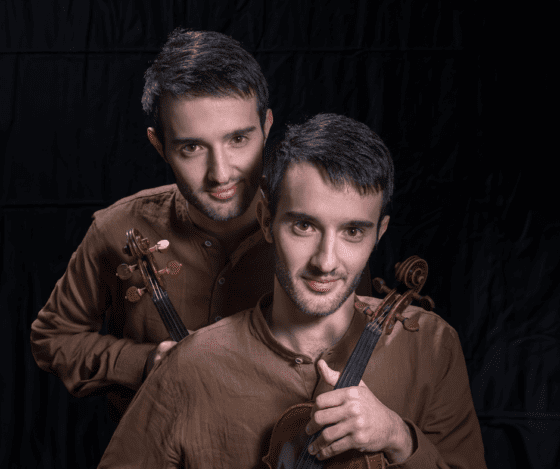
Hello, I Musici Gemelli. What inspired you to create an album entirely centered on the life of Christ?
The starting point was a spiritual intuition: to recount the life of Jesus not as a simple narrative cycle, but as an inner journey, punctuated by sound images. Together with the composer, Emanuele Stracchi, we began to imagine twelve “musical tableaux,” each with its own color and atmosphere. The narrative follows both a theological and human journey: birth, revelation, passion, and resurrection.
Musically, we constructed a vast sound parable lasting about 50 minutes, combining narration and meditation. For the first time in the history of music, the entire life of Jesus Christ, from his birth to his resurrection, is interpreted by such a small ensemble (two violins).
How did you approach conveying such deep emotions through just two violins?
Translating pain and loneliness, but also dignity and fulfillment, into sound was a deeply human task! The album, Jesus Of Nazareth (World Premiere), stems from a desire to combine spiritual depth, formal exploration, and sonic humanity. Its uniqueness lies precisely in its “poverty of means”: two voices intertwine to recount the entire life of Christ.
This choice becomes a symbol of purity and a return to the essence, encouraging intimate and, in many ways, contemplative listening. From a technical point of view, the violin work required particular care: some sound effects were complex to recreate and every detail was studied with precision. The balance between the two instruments was essential to maintain expressive unity and bring out the emotional intensity of each passage.
Can you explain how composer Emanuele Stracchi’s use of sacred music traditions influenced the album?
The influence of sacred music traditions on the album is evident above all in its very structure: Emanuele chose to insert a Canon every three tracks, like a Trinitarian breath that runs through the entire work. This formal choice is not only technical, but symbolic: Stracchi wanted the music to be able to narrate and meditate at the same time, reflecting the spiritual tension typical of liturgy.
On this sacred basis, the composer has grafted some features particularly dear to him: counterpoint, the purity of the melodic line, clear and rigorous writing, and the use of modal scales. Alongside the legacy of sacred music—from Bach to the great polyphonic school of Palestrina—the influences of other composers who have illuminated Emanuele’s path also emerge: Mozart, Dallapiccola, Ligeti, Pärt, Williams, and Morricone.
Their voices, so different and recognizable, seem to resonate like distant reflections, merging with the spiritual dimension of the work. The result is a renewed musical proposal that looks ahead but remains deeply rooted in sacred traditions.
Which movement or scene was the most challenging to perform, and why?
The most difficult scene to perform was the crucifixion. The complexity of the performance requires great sensitivity. In this movement, the violins intertwine and then separate, as if one voice rises while the other fades away. It is a passage that requires extreme finesse in its execution: a moment of silence and suspension in which even the dissonance must sound like a form of prayer.
What message or feeling do you hope listeners take away from Jesus of Nazareth?
With this album, we want to reach people and artists by telling a story of love and hope. Music can reach people, giving love and comfort, becoming a light that accompanies and sustains them. The essence of the Christian message is simple and powerful: “Do not be afraid.”
Listen To I Musici Gemelli Below

- Louise Aubrie Returns With “Vienna” - July 3, 2026
- Heidi Martin, “Attunement” – New Music - June 19, 2026
- Has Pop Music Gone Stale? - April 17, 2026

