
Content Guide
Kiss All the Time. Disco, Occasionally Review: Harry Styles’ fourth studio album Kiss All the Time. Disco, Occasionally. already feels like the most daring creative leap of his career. A synthesizer soaked, house inflected dance record born from a year living in Berlin and a near obsession with LCD Soundsystem, it arrives after almost four years of near total silence. His longest stretch away from music since he first joined One Direction at sixteen years old.
Early signs suggest it will divide critics and fans in equal measure, even while it storms the commercial charts. With twelve tracks, no featured artists, and Kid Harpoon producing for the fourth album in a row, this is a deliberate gamble on Styles’ part. He has swapped the synth-pop warmth and intimacy of Harry’s House for something louder, sweatier, and far more outward facing. Something designed to be felt in a room full of strangers rather than alone at home.
The stakes feel enormous. Harry’s House won Album of the Year at the 2023 Grammys and shifted over half a million units in its first week. The lead single “Aperture” debuted at number one on both the Billboard Hot 100 and the UK Singles Chart, then dropped sharply in week two. Projections put the album somewhere between 500,000 and 600,000 first week units, which would be Styles’ strongest commercial debut yet. But the divisive critical reaction to “Aperture” has injected a genuine element of uncertainty into what is otherwise one of the most carefully orchestrated album campaigns of 2026.
From Jamaica to Berlin: The Arc of Four Albums (Kiss All the Time. Disco, Occasionally Review)
To understand just how much Kiss All the Time represents a shift, you have to trace where Styles started and how far he has come.
His self-titled debut in 2017 was a love letter to classic rock, drawing on the Beatles, Pink Floyd, and Fleetwood Mac. Recorded partly during a two-month writing retreat in Jamaica, it produced “Sign of the Times,” a soaring six-minute ballad that went to number one in the UK. Critics respected the ambition but noted the album leaned heavily on its influences. It opened at number one in America with around 230,000 units. A genuinely impressive start, though one that still positioned him as a former boy band member working hard to prove himself.
Fine Line in 2019 felt like a real step forward. Leaning into psychedelic pop, funk, and folk, it gave him his first US number one single with “Watermelon Sugar” and debuted with 478,000 first week units, making it the biggest opening week for a British male artist in chart history at that point. Critics warmed to it considerably.
Then came Harry’s House in 2022, inspired by Japanese city pop and the work of Haruomi Hosono. “As It Was” spent fifteen non-consecutive weeks at number one on the Hot 100 and became the best-selling global single of 2022. The album picked up three Grammys. Each record had been more acclaimed than the last, more commercially successful, more unmistakably his own.
After finishing Love On Tour in the summer of 2023, a run that grossed over $600 million and ranked among the highest grossing tours in history, Styles simply walked away. He ran two World Marathon Majors. He attended Liam Payne’s funeral. He moved to Berlin.
What Two Years Away Actually Looked Like (Kiss All the Time. Disco, Occasionally Review)
The move to Berlin drew obvious comparisons to David Bowie’s own creative retreat to the city decades earlier, but Styles has been clear that what drew him there was simpler and more personal than any grand artistic statement. He was meeting interesting people, hearing music he had never encountered, and spending long evenings on the other side of the experience he had spent years delivering from a stage.
He talked about it in his SiriusXM interview with John Mayer. He said the most important thing those two years gave him was the feeling of being in a crowd again, dancing alongside strangers, rediscovering what it actually feels like to be an audience member rather than a performer. Touring life, he explained, slowly closes in around you. The circle of people you trust gets smaller. The corners come in. For him, those years in Berlin were about deliberately reversing that process.
Seeing LCD Soundsystem live in Madrid and at Brixton Academy became a turning point. He described the experience as simply joyous, the kind of feeling he wanted to recreate from the stage rather than just the stalls. That shift in perspective, from performer to audience member and back again, became the conceptual engine of the whole record.
Recording happened at RAK Studios near Regent’s Park in London and in Berlin, with Kid Harpoon making extensive use of modular synthesizers throughout. Styles described the process itself as looser than anything he had done before. Rather than grinding through set studio hours, he would go weeks just living his life and let songs arrive when they were ready. He also played demos for friends throughout, something he had actively avoided on previous albums, having come to feel that the secrecy was turning the music into a product. He wanted to reverse that.
Twelve Tracks and a Very Important Comma (Kiss All the Time. Disco, Occasionally Review)
The full tracklist runs as follows, in order: Aperture, American Girls, Ready Steady Go!, Are You Listening Yet?, Taste Back, The Waiting Game, Season 2 Weight Loss, Coming Up Roses, Pop, Dance No More, Paint By Numbers, and Carla’s Song.
The album runs to around 42 minutes across those twelve songs. There are no deluxe editions, no bonus tracks. The title itself became a minor talking point when Styles described it to John Mayer in characteristically sideways terms, explaining that the disco is optional in the way that peeing while drinking water is optional. The idea being that kissing is the constant, and the disco is what you can take a break for. He was emphatic that the comma between “Disco” and “Occasionally” is correct and essential. He said so more than once.
Fans quickly noticed what looks like a structural duality running through the campaign. Apple Music split his catalog into two separate playlists, one called “Kiss All the Time” and one called “Disco, Occasionally.” Merchandise appeared in two colorways, pink and blue. A clock on the promotional website showed “Kiss” repeated across most of its face with “Disco” marking the ninth position, the pink and blue hands moving in opposite directions. Whether the album itself splits cleanly along those two poles remains to be confirmed on release day. People who attended the global listening parties reported that the record contains a striking variety of sounds, including slow ballads and rock-influenced moments alongside the expected dance material.
“Aperture” Arrived Like a Mission Statement and Split the Room (Kiss All the Time. Disco, Occasionally Review)
Released on January 22, “Aperture” runs to five minutes and eleven seconds and is built like a progressive house track, a slow-building electronic piece driven by house piano and a deliberate, almost patience-testing structure that withholds its payoff for a long time. It debuted at number one on the Hot 100 with over 18 million streams and more than 27 million radio impressions in its first week, and set a record for the biggest global debut-day streams on Spotify for any solo male artist.
The music video, directed by Aube Perrie with choreography by Ryan Heffington, is set in a brutalist Los Angeles hotel. Styles is followed by a mysterious stranger, played by actor Danny Dolan, through a tense chase sequence that eventually dissolves into synchronized dancing and ends on a spectacular lift. Critics compared it to Spike Jonze’s “Weapon of Choice” video and to Bowie’s “I’m Afraid of Americans.”
The critical response was genuinely split. NME gave it 80 out of 100 and called it one of the boldest sounds in his catalogue. The Guardian praised it. Consequence of Sound said it felt lightyears from “Watermelon Sugar.” Pitchfork, on the other hand, argued that Styles was the least interesting element of the track and questioned whether the slow burn earned its runtime. The Fader called it plodding and suggested it aimed for euphoria but landed somewhere more muted.
That second-week chart drop after the explosive debut raised questions. His BRIT Awards performance in late February, his first live appearance since the 2023 ceremony, appeared partly designed to push back against that narrative. He performed with elaborate choreography, dancers, and a full choir, reframing the song as a far more explosive live experience than the studio recording alone suggests.
A Campaign Built on Both Intimacy and Scale (Kiss All the Time. Disco, Occasionally Review)
The rollout for this album has been genuinely clever. It started on December 27, 2025, with a video on YouTube called “Forever, Forever,” splicing footage from the final Love On Tour show with a piano ballad Styles wrote for that night, ending with the words “We Belong Together.” Two weeks later, posters bearing that phrase appeared in cities around the world, directing fans to an interactive website that fed into a WhatsApp text chain, an unusually personal promotional mechanism for an artist at this level. Voice memos of Styles humming followed.
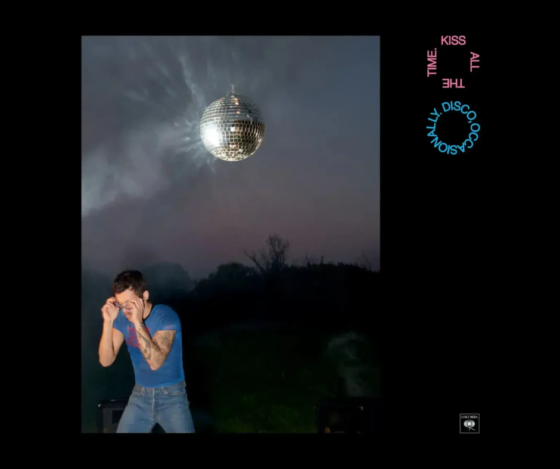
The album was formally announced on January 15 via Instagram, alongside the cover artwork showing Styles standing in a wooded area at night, back partially turned, beneath a disco ball suspended in mid-air. He wears jeans, a t-shirt, and swimming goggles. The title appears in bright pink and blue lettering. It is a strange and quietly perfect image, an outdoor scene interrupted by an incongruous object that has no business being there, which feels like a neat visual summary of what the album is trying to do.
Physical formats include standard vinyl, CD with a 20-page booklet, cassette, and three limited-edition vinyl variants named Smoke Machine, Kiss, and Tomato. There is also a deluxe box set with a limited-edition film camera.
The campaign’s biggest set pieces are still to come. A one-night-only concert at Manchester’s Co-op Live on March 6, the album’s release date, will be filmed for a Netflix special streaming two days later on March 8. He then hosts and performs on Saturday Night Live on March 14. Global listening parties across 40 cities from February 18 onward generated the kind of fan reactions that money cannot entirely manufacture. One attendee in Dublin simply said it was the best album she had ever listened to.
Themes of Openness, Joy, and the Dance Floor as a Place to Belong (Kiss All the Time. Disco, Occasionally Review)
The thematic thread running through everything Styles has said about this record is one of opening up after a long period of closing in. “Aperture” is not an accidental title. The word refers to the opening in a camera lens that lets light enter. Styles has described the years before this album as a gradual narrowing, of trust, of friendship circles, of the world he allowed himself to experience. Berlin, the club scene, LCD Soundsystem at Brixton, dancing with strangers until late became the corrective to all of that.
Where Harry’s House turned inward and dealt with the texture of domestic life and private feeling, this album appears to face outward. The recurring phrase “We Belong Together,” woven through the promotional campaign, the chorus of “Aperture,” and the name of the tour itself, Together Together, encodes the central thesis. The album was made to be heard in a crowd. Styles has said it is meant to be played loud. He wanted music that came from the dance floor and could return to it.
His approach to writing on this record also reflects that philosophy. He stopped trying to force the songs and let life lead instead, trusting that the weeks spent living in Berlin would eventually produce something worth recording. “If I spend two weeks just living my life and then a song happens,” he said, “it was the last couple of weeks of my life.”
What to Expect on March 6 (Kiss All the Time. Disco, Occasionally Review)
No major full album reviews have landed yet as of the day before release. Those are expected on or around March 6. But the shape of what is coming feels fairly clear.
Commercially, this is going to be enormous. Projections place it among the biggest debuts of 2026. The tour that follows is staggering in its ambition: 30 nights at Madison Square Garden, 12 nights at Wembley Stadium, residencies across Amsterdam, São Paulo, Mexico City, Melbourne, and Sydney. Jamie xx, Robyn, and Jorja Smith are among the support acts across different dates.
Critically, the record sits in interesting territory. The divisive response to “Aperture” has set up a genuine question about whether the full album justifies the stylistic leap. The comparisons being drawn to LCD Soundsystem, Robyn, and Jamie xx signal real creative ambition. But the cautionary tales of artists who changed their sound and lost the audience in the process are never far from the conversation when artists make moves this bold.
The listening party reactions lean heavily positive. Attendees reported being surprised by the range on offer, by how much the album diverges from what “Aperture” alone would suggest. One thing Styles said that stuck with me, even before the album is out, was the idea that spending years on stage had made it too easy to forget what a crowd feels like from inside it. Kiss All the Time. Disco, Occasionally. sounds like an artist who went back into the crowd, remembered what it felt like, and then came home to write about it. Whether that translates fully onto record, we will all find out on Friday.
Listen To “Kiss All the Time. Disco, Occasionally” By Harry Styles (Kiss All the Time. Disco, Occasionally Review)

He discovered the gem when he was 12 years old and still has it now, claiming it to be why he fell in love with music. He likes to play disc golf when he's not writing about music. He is a one-of-a-kind individual who is always the first to bust out his air guitar on the dance-floor.
- Does Anyone Even Watch Eurovision Anymore? - April 21, 2026
- How Joy Division Rewired Robert Smith’s Blueprint - April 15, 2026
- Your Favorite Toy Review – Foo Fighters – Album Review - April 9, 2026

